Using hand signals with English language learners can help communication go far beyond words. Sometimes, a simple gesture, or hand signal, can bridge the gap between confusion and clarity. In my upper elementary ELD classroom, I use consistent hand signals to help my English learners understand expectations, follow directions, and participate in speaking routines. These visual cues not only support comprehension, but they also build confidence and independence.
In this post, I share four of my favorite hand signals that have become part of our daily classroom rhythm. They’re simple, effective, and easy to implement—whether you’re working with newcomers or multilingual learners at any level.
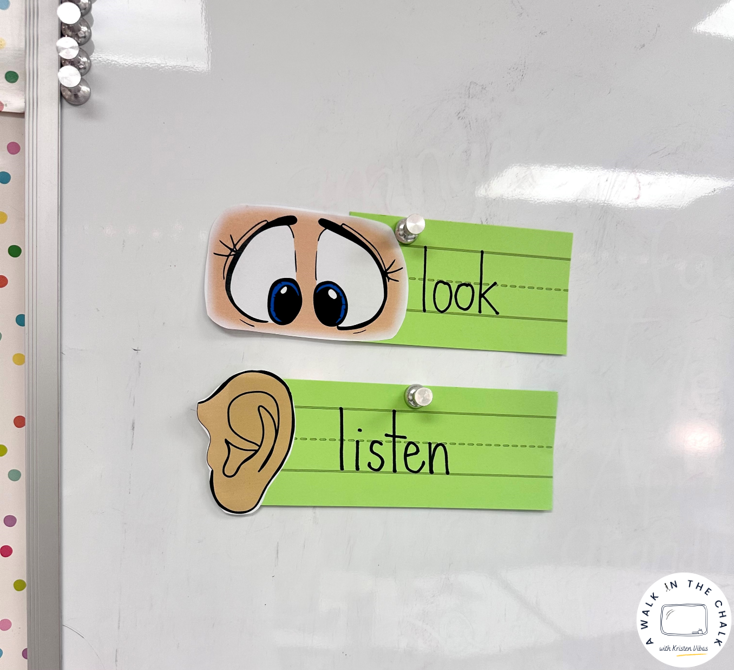
When I need my students’ full attention — whether to share important information or to redirect the focus lesson– I use a hand signal for “Look & Listen.” It’s exhausting for newcomers to intake information all day long; the cognitive overload can be a lot. A visual reminder that their full attention is required in that moment is a way to support students during the often challenging initial few months in a new school immersed in a new language & culture. I also use this signal when pushing into Gen Ed classrooms during the whole group focus lessons as a gentle reminder.
Hand Signal: Tap my pointer finger (for the number 1) to my eye, then tap two fingers (for the number 2) to my ear.
I want my students making connections between what they see visually with what they’re hearing, so this simple reminder does the trick.
I also have a visual reminder that I use when initially introducing this gesture.
I often push my students to stretch out their oral responses, not just my newcomers, but all my English learners. When students respond with a word or phrase, I cue them to restate their response using a complete sentence.
Hand Signal: Cup each hand touching fingertips together. Connect hands at the fingertips, then pull apart to demonstrate a s-t-r-e-t-c-h-i-n-g out motion, as if stretching an uninflated balloon.
My students know exactly what to do when I use this hand signal and will restate their response using a full sentence. It’s a great tool for extracting more language and building expressive skills, as well as reminding students to use correct sentence structure and avoid one-word responses.
Modeling and support, especially in the beginning, is key to making this cue an instant reminder.
This gesture is similar to “use a complete sentence,” but rather, it signals to add more details to oral responses.
Hand Signal: Pinch thumb and pointer fingers together and gently move them apart, like showing a “small” amount expanding (similar to “stretching it out,” but more about detail than sentence structure).
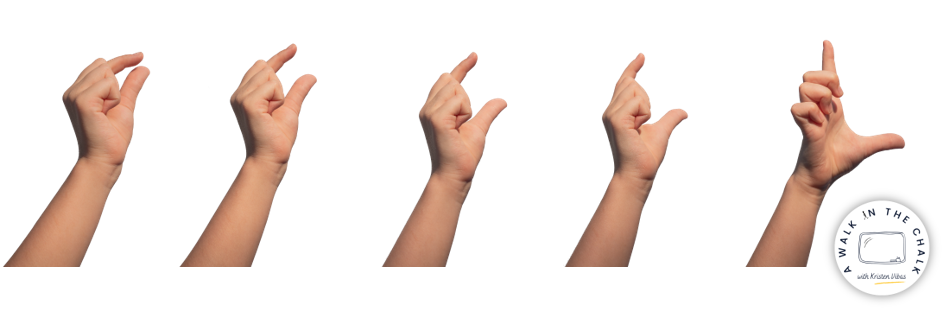
The purpose here is to encourage elaboration or adding one more idea. This helps ELs understand they need to give fuller answers.
When I want students to echo a word, phrase or sentence, I use a hand signal to prompt them to “Repeat After Me.”
Hand Signal: First, cup one hand behind the ear (a universal gesture for listening). Next, move that hand vertically to the mouth and move it away in a smooth straight forward motion. This visual cue lets students know it’s time to repeat what they hear. It’s especially helpful for newcomers, or beginning English learners, who benefit from hearing and practicing modeled language.
I use this with sentence frames, vocabulary routines, and when I want students to build fluency and confidence.
These hand signals may seem small, but they’ve made a big difference in my classroom. By pairing gestures with language, I’m able to reach my students in a way that’s immediate, supportive, and inclusive. Over time, these cues become part of our shared language—a quiet reminder that helps students participate more fully and confidently.
Do you have favorite hand gestures for your ESL classroom? I’d love to hear about them! To learn more about using hand signals to create a more equitable experience in the classroom, here’s a great article on Edutopia.com.
Lastly, if you’re looking for ways to include newcomers in general education classroom lessons and activities, check out this post and share it with your gen ed colleagues!
Happy teaching!