
Writing sub plans is never fun—especially when you wake up sick or have an unexpected emergency. For elementary ESL and ELD teachers, it can feel even more complicated. You may teach several grade levels, work with students at a wide range of English proficiency levels and follow a schedule that makes perfect sense to you but may not be quite as easy for someone else to step into.
That is why I like to keep a few meaningful, yet simple, emergency activities prepared and ready to go.
But here is the most important thing I have learned about creating sub plans:
Don’t put anything in your emergency plans that your students haven’t done before.
A substitute should not have to introduce a brand-new activity. Instead, your students should look at the activity and think, “Oh! We know how to do this!”
When the routines are familiar, students can work more independently, the substitute can focus on facilitating, and the day is much more likely to run smoothly.
The best sub plans for an elementary ESL classroom are:
You do not need to recreate your regular instruction for a substitute. The goal is to leave language-rich activities your students recognize and can complete with confidence.
These aren’t activities I save only for a substitute—they are also some of my favorite go-to ELD lesson activities for regular instruction. I often use them as grab-and-go lessons because they are engaging, adaptable, and effective for building language across proficiency levels.
Here are five activities I recommend teaching ahead of time and keeping ready for a planned or unexpected absence.
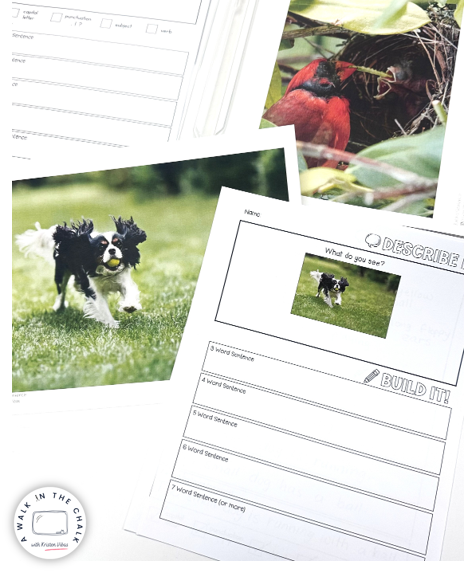
Picture-based sentence building is one of my favorite choices for elementary ESL sub plans because visuals give multilingual learners immediate access to the task. Students can begin by observing and naming what they see before being asked to speak or write.
With Build a Sentence, students use an engaging photograph to generate vocabulary and create increasingly detailed sentences. They might first describe a dog running with a ball or a bird feeding its babies. Then they use the same picture to build three-, four-, five-, six-, and seven-word sentences.
The activity is naturally differentiated. Students who are beginning to develop English can label the picture or create a short sentence. More proficient students can add adjectives, prepositional phrases, and other details. Because the response levels are built into the activity, a substitute does not have to create separate lessons for every group.
Before students write, have them rehearse their sentences aloud with a partner. This keeps oral language at the center of the activity and gives students an opportunity to hear and revise their ideas before putting them on paper.
Why it works for a substitute: The visual makes the task clear, students can work at their own level, and the familiar speaking-to-writing routine requires very little explanation.
Answering in a complete sentence is an important academic language skill—and it is one students can practice with almost any topic.
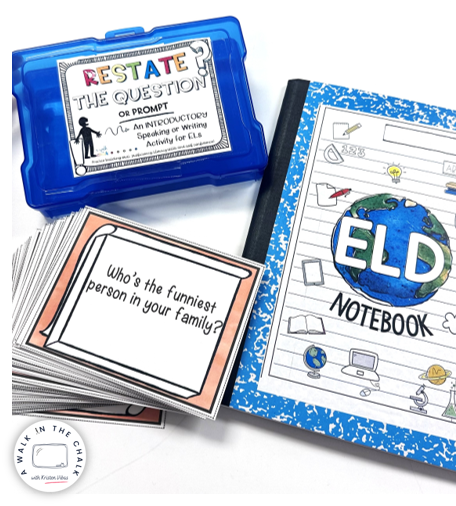
The Restate the Question activity gives students a question or prompt, such as Who is the funniest person in your family? Students learn to borrow words from the question to begin their response:
The funniest person in my family is ____.
This predictable routine helps students move beyond one-word answers while building oral proficiency, literacy skills, and confidence. It can be used as a speaking activity, a writing activity, or both.
For a sub day, students can take turns selecting cards and answering the prompt. The substitute can model the first question, ask the class which words should be repeated in the answer, and then allow students to continue using the routine they already know.
To add writing practice, students can write in their ELD notebooks. Beginning students may copy the restated sentence starter, while more proficient students can add a reason, example, or supporting detail.
Why it works for a substitute: The routine stays the same even as the questions change, and it provides a clear structure for both speaking and writing.
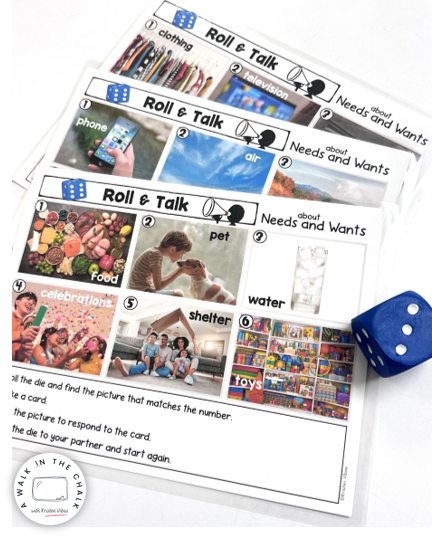
Roll & Talk Mats turn partner talk into a simple, predictable routine. Students roll a number cube, find the corresponding picture, and respond to a related question card. Then their partner or group member takes a turn.
The photographs support comprehension and activate vocabulary, while the question cards provide the purpose for speaking. Language scaffolds are included directly on the cards so students have the words and sentence structures they need to respond.
For example, on a Needs and Wants mat, students might roll a number connected to food, water, shelter, a phone, television, or toys. They can then explain whether the item is a need or a want and support their answer.
Before adding Roll & Talk mats to your emergency plans, make sure students know:
Once those procedures are familiar, this activity requires very little teacher direction. You can also leave a recording sheet and ask students to write one or two of their responses after the partner conversation.
Why it works for a substitute: Students follow the same repeatable steps, the visuals and language supports are already included, and the activity gets everyone talking.
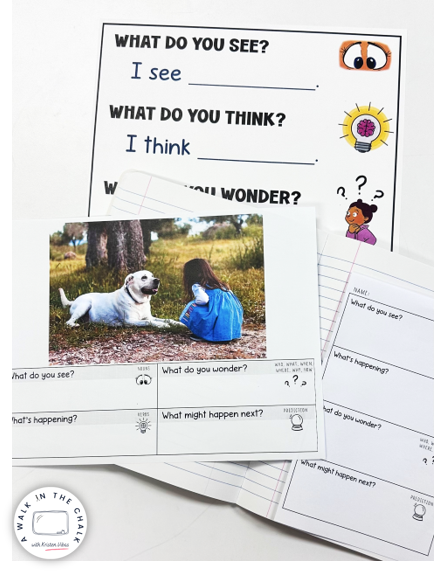
An interesting photograph can generate an entire language lesson. Rather than asking students to jump directly into writing, picture prompts allow them to observe, think, wonder, predict, and talk first.
I use four consistent questions:
These questions move students from concrete observation to more complex thinking. A beginning multilingual learner might name visible nouns or complete the frame I see ____. Another student might describe the action, ask a question, or make a detailed prediction using evidence from the photograph.
For sub plans, leave one or more photographs along with the familiar response page. The substitute can display a picture, give students quiet observation time, and then guide them through the four prompts. Students can share their thinking before recording their ideas.
The same routine works across grade levels because the depth of the response can change. Younger or beginning students may draw, label, or write one sentence. Older or more proficient students may write a short paragraph that connects their observations, inferences, questions, and predictions.
Why it works for a substitute: One photograph supports multiple levels, the four prompts guide the entire lesson, and students can move naturally from oral language to writing.
Most students love sharing their opinions—especially when they are choosing between two interesting options!
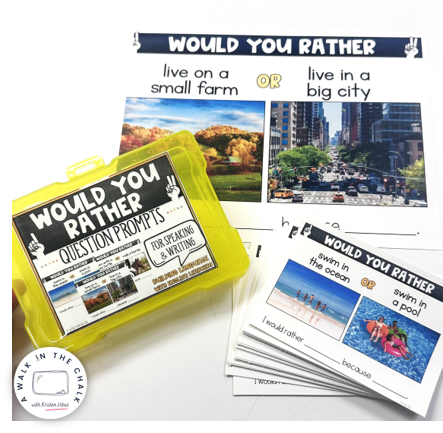
Would You Rather? prompts give multilingual learners an engaging reason to talk while helping them practice stating a preference and supporting it with a reason. Students might choose whether they would rather live on a small farm or in a big city, or whether they would rather swim in the ocean or in a pool.
The visual choices make the questions easier to understand, and the consistent sentence frame supports a complete response:
I would rather ____ because ____.
Students can begin by discussing the prompt with a partner or physically moving to one side of the room to show their choice. They can then listen to classmates’ reasons and record their own response in writing.
To extend the activity for more proficient students, ask them to include two reasons, compare both choices, or respond to a classmate:
Why it works for a substitute: The activity is highly engaging, the format stays consistent, and students can participate successfully at different language levels.
Your emergency plans do not need to be elaborate. A clearly labeled folder or bin makes them easy for a teammate or substitute to find.
Consider including:
Write directions as if the person reading them has never visited your classroom and is not an ESL/ELD specialist. Keep each step brief and specific.
The most important preparation happens before your absence.
Introduce each activity during your regular instruction. Model it, practice it together, and use it enough times that students understand both the academic task and the classroom routine. Then print an extra set, add simple directions, and place it in your emergency folder.
You do not have to prepare five completely different lessons. Any one of these activities can be expanded into a full class period by following a simple oral-language-first sequence:
This familiar structure keeps students listening, speaking, reading, and writing without asking the substitute to teach new content.
TIP: Give yourself peace of mind by preparing an Emergency Sub Folder now, before you need it. Putting one together will likely be the last thing you feel up to doing if you actually need it. 💛
Before you go, check out “6 Engaging Warm-Up activities!” Some will look familiar;)
Happy teaching,