


Reading grade-level text can feel overwhelming for beginning and intermediate multilingual learners. Unfamiliar vocabulary, long sentences, and new content can make it difficult to keep up.
Three strategies for multilingual learners I use to support students are drop-in reading, choral reading, and echo reading. Each gives students a way to participate without the pressure of reading aloud on their own.
All three strategies model fluent reading, including pronunciation, phrasing, and expression. They can also reduce anxiety, build confidence, and support comprehension. And while I use them with multilingual learners, they can benefit any student who needs reading support.
Before introducing a text, I tap into what students already know and build knowledge to prepare them for the content ahead. This might include a guiding question and discussion, a short video clip, or a pictorial input chart.
I use pictorial input charts to build understanding, vocabulary, and oral language around a topic. Students hear and use the language before encountering it in print. When we begin reading, they have something familiar to connect to.
Before reading about woodpeckers, my fourth graders learned about the bird’s appearance, habitat, diet, and behaviors through a pictorial input chart. Words such as beak, bark, and insects were already familiar when students encountered them in the text.
Check out these 3 reading routines that help students access complex texts.
With drop-in reading, I read the text aloud while students follow along and track the words. When I reach a bolded word or phrase, I pause, and students “drop in” their voices to read it together. Then I continue until the next bolded word.
For example:
A woodpecker uses its strong beak to make holes in trees. It searches beneath the bark for insects.
I read the sentences, and students join in on beak and insects.
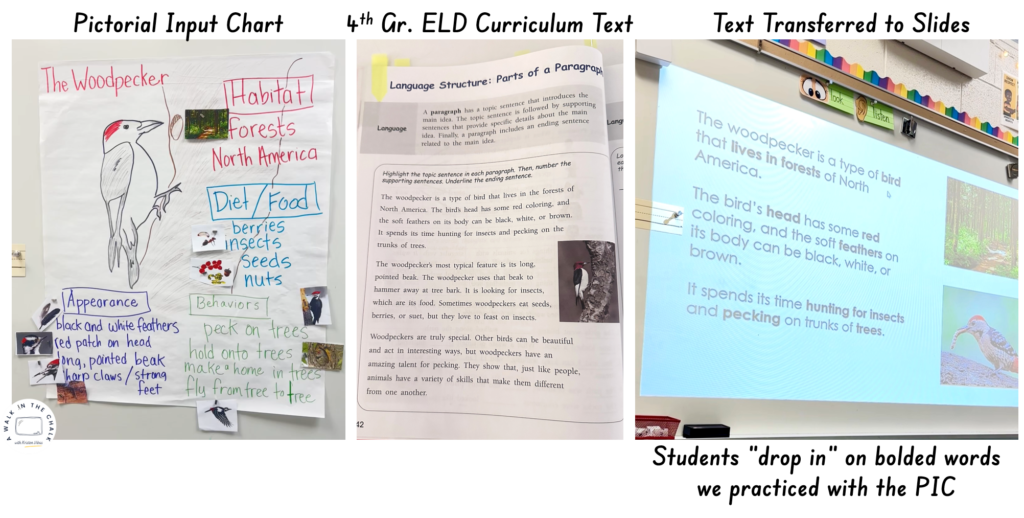
Students follow with their eyes, a finger, or a reading guide so they know when to join in. My reading keeps the pace moving, and students participate a few words at a time without having to tackle the whole paragraph independently.
Drop-in reading works great with other activities too! Here is a slide I recently used to introduce a writing lesson to a fifth-grade classroom. Students “dropped in” their reading during this explanation of an opinion. It’s a great way to keep students engaged during a lesson.
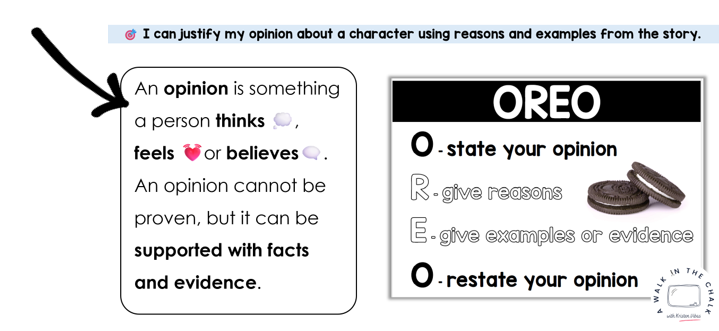
Try it: Use vocabulary already bolded in your text, or select a few words yourself. Model how you’ll pause and let students know that they’ll read those words together.
With choral reading, the teacher and students read the text aloud together, in unison.
Everyone participates, but no individual student is put on the spot. Reading with the group can lower the affective filter—the worry or discomfort that can make students hesitant to participate—and help students feel more confident.
I have found this strategy to be particularly useful in my ELD small groups since my district adopted an ELA/ELD curriculum.
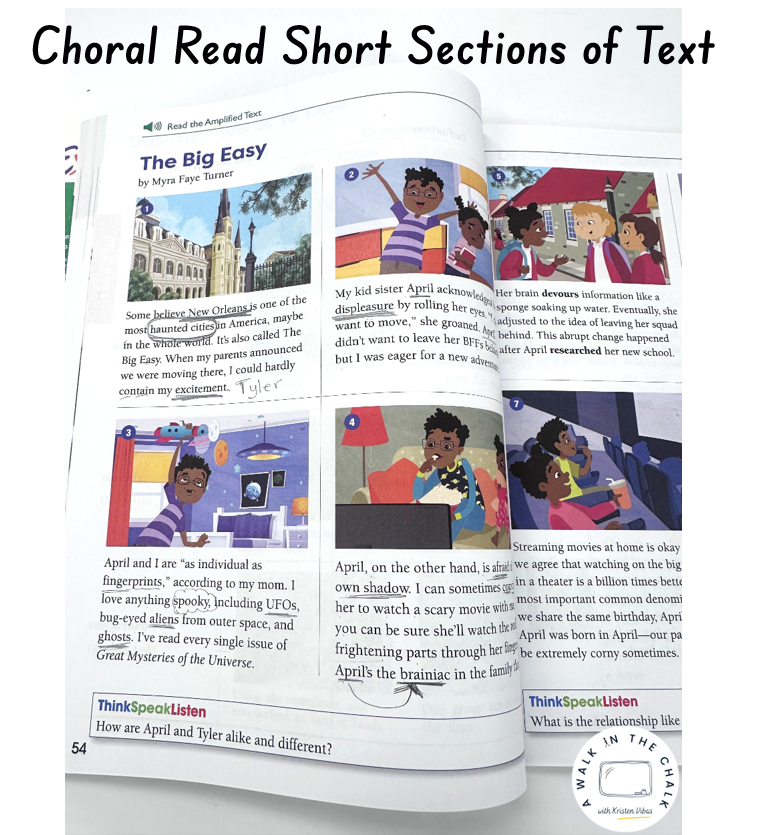
As we read together, my voice provides a model of pronunciation, phrasing, and expression. Students have support as they participate in reading text they may not yet be ready to read independently.
This routine may take some modeling and practice. Students need to understand that the goal is to read together at the same pace. I start with a short section and use a comfortable pace so students can track and join in.
Try it: Start with a few sentences. Give students a clear signal to begin and keep your voice audible so they can follow your pace.
With echo reading, I read a word, phrase, or sentence aloud, and students reread that same part of the text.
I decide how much to read based on what students can comfortably repeat. For a longer sentence, I break it into shorter, meaningful phrases.
For example, I might read:
“A woodpecker uses its strong beak”
Students repeat that phrase. Then I read:
“to make holes in trees.”
Students repeat again. After practicing the phrases, we can read the complete sentence together.
Students hear the language first and then have an immediate opportunity to practice it. This is especially helpful when a text includes unfamiliar words or longer sentences.
My 4th graders had already practiced beak with the pictorial input chart, however, if it were unfamiliar, I’d pause to explain it with a gesture, sketch, or photo.
Try it: Break longer sentences into short, meaningful phrases. Keep the chunks manageable while preserving the meaning of the sentence.
Here’s an example of grade-level text from my district’s 5th grade ELA curriculum.
Before reading Rainfall Saves the Day, I would begin with a brief knowledge-building lesson on monsoons. A pictorial input chart could show how seasonal rains supply water for people, crops, and animals, and what happens when that rain doesn’t arrive.
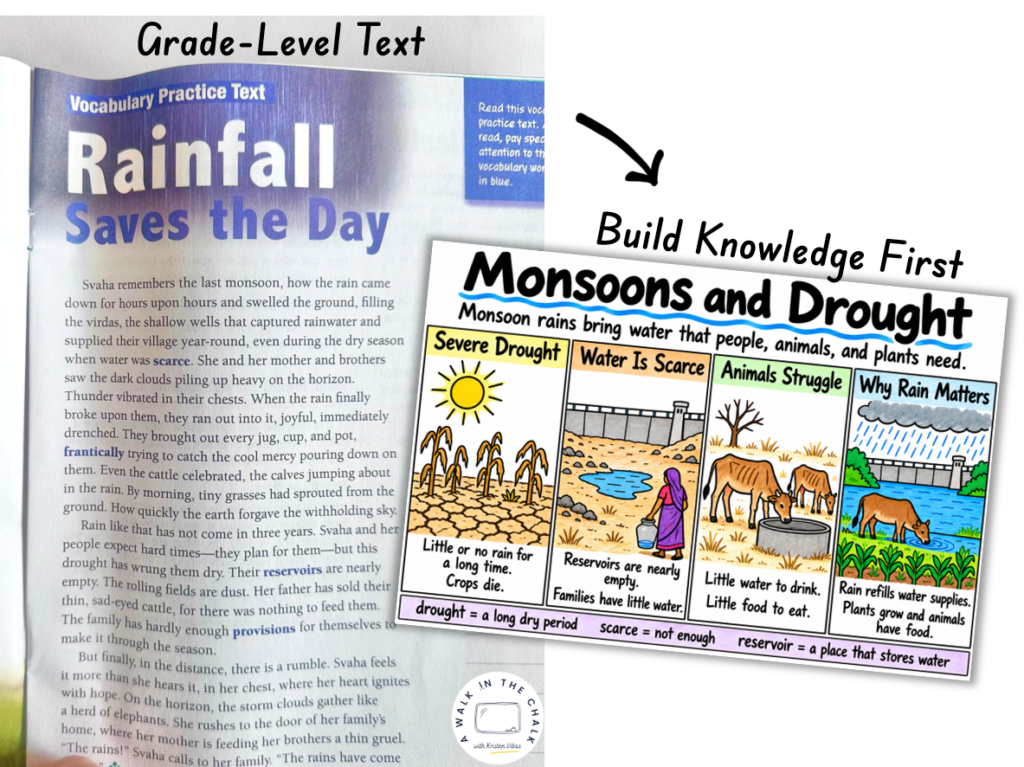
Instead of a PIC, I might frontload essential vocabulary with visual supports. Students hear and practice essential vocabulary such as monsoon, dry season, drought, and reservoir before reading.
With a foundation in place, we’re ready to connect our learning to the text.
For this passage, I would start with echo reading, breaking longer sentences into meaningful phrases. For example:
Teacher: “She and her mother and brothers”
Students: “She and her mother and brothers”
Teacher: “saw the dark clouds piling up”
Students: “saw the dark clouds piling up”
Teacher: “heavy on the horizon.”
Students: “heavy on the horizon.”
As students follow along, they hear how I pronounce the words and group them into phrases that carry meaning. Then they practice that same language with the support of their classmates.
After reading a short section, we pause to discuss: Why was the rain so important to Svaha’s village? Students can refer to the pictorial input chart and/or the text to explain their thinking.
Once students have practiced the section through echo reading, we can reread it using choral reading, with everyone reading together. This gives students another opportunity to practice the language with some familiarity and greater confidence.
Following along and saying the words doesn’t always mean students understand them. We still need to pause, clarify, and talk about what we’re reading.
This is where the pictorial input chart comes back in handy.
After reading about the nearly empty reservoirs, I could point to the chart and ask, “Why is there so little water?”
One student might point to the dry land and say, “No rain.” Another might explain, “The reservoirs are nearly empty because there has been a drought.”
Both responses give me information about what students understand and the language they can use to express it.
If you’re looking for more ways to help your multilingual learners understand and participate in grade-level lessons, take a look at my Making Content Accessible for Multilingual Learners workshop. I share classroom examples and practical strategies for making content visible, making language visible, and getting students talking—plus resources to help you get started.
Explore the self-paced workshop here.✨
You don’t need to use all three strategies with every text. And you don’t need to incorporate a pictorial input chart with every reading. Choose the routine that fits your students and your purpose.
Drop-in reading invites students to track closely and join in on selected words. Choral reading provides supported practice with the whole group. Echo reading gives students an immediate model to hear and repeat in manageable chunks.
Start with a short section of a text you already use. Build knowledge and language first, provide support during reading, and make time to discuss the meaning.
With these simple routines, beginning and intermediate multilingual learners can take a more active role in reading grade-level text while continuing to develop their language and confidence.
Happy teaching,